Tuesday, December 14, 2021

Watching a Forest for a Season

 Living in a Forest

I consider myself somewhat of an outdoorsman.  I love being out in nature and experiencing the weather, the flora and the fauna as it goes about its business. For the first time in my life, I have spent the turning of the seasons, living inside a forest. Watching it change and come to life as the days grew longer and then shorter again. 

We arrived at the foot of Bob's Hill, part of Catoctin Mountain, at the end of March. Spring was getting underway, but still had some way to go.  The day we arrived a sleet that turned into a snow squall blew over the mountain and dropped the first flakes on my shoulders that I had avoided the whole of the winter.  


Site 15

We settled into Site 15. It was close to perfect.  The site was plenty big enough for the coach, and level.. There was a nice running stream named Muddy Run right behind the site that Ginger would use to cool herself off later in the season.  The bathhouse was just down the path and we really didn't have any close neighbors. 


Spring

The forest was still mostly asleep when we arrived.  We were at the base of a mountain and Spring was underway, but still coming on.  You could easily see through the whole campsite at this time, since the undergrowth hadn't started growing yet.  

Easy to see through the trees


Mayapple

Daffodils

The stream was running fast and full. Some of the trees were starting to bud and a few of the flowering type were sending out their blooms.  The forest felt like it was slowly waking up.

Summer

As the trees began to leaf out and the undergrowth came out, the campground started to close in.  Where we used to be able to see easily across the campground, was now just a wall of trees.  You had to actually walk around the camp to see all the sites and campers. 


Ferns

Ginger cooling in Little Hunting Creek

The stream slowed to a little more than a trickle, but was present the whole summer. 

With the warm weather, came the cicadas. Brood X was hatching and early on, we saw many signs of them coming out. Small holes in the ground under the leaves and one or two here and there.  This trickle soon became a torrent and the cute bugs with bulging red eyes took over the forest. Their cacophony filled the hillside and they were everywhere.  We enjoyed them being around.  They were harmless and fun to play with.. 


Cicada Love

Drawn to the only light source in the forest

I named this one Clyde

Lisa would pick up the ones that came dive bombing into camp and release them on a tree.  We would spend the next several minutes watching it climb to the top.  

Wildlife

From day one we started seeing several deer that lived on the hillside and routinely moved from up the hill through the camp to the open grass down below.  There were also several female turkeys that would walk through camp. Later their brood could be spotted moving from one campsite to the next, looking for bugs and scraps as they followed their mothers up the hill. The snakes and bears also came out as the season changed.  We started seeing different snakes. Garter and Black snakes at first. Then copperheads and rattlers.  I had a copperhead slither into my camp one day as Ginger and I were sitting outside enjoying a lazy afternoon.


Rattle Snake

Copperhead

Garter

On another day, Ginger and I were outside and i spotted a bear moving along the creek on the hillside above our camp.  It crossed the creek and passed about 100 feet away. When Ginger saw it, she started barking and scared it up the hillside.  It was an exciting experience.

I became proficient at picking up snakes with the tools the ranger game me and releasing them across the creek and up the hill.  

The forest came alive with the warm, summer weather.  


Relaxing by the fire

Our nomad garden

A Break From the Forest, Then Fall

In July, we left the Manor and went exploring in the general area, but we came back in late September and got to experience the forest changing from high summer to fall.

When we left, the wine berries were just getting ripe.  We had been waiting for them to get ready for several weeks. They are so good.  


Wine Berries

As the year moved on, the leaves started turning and falling and covered the forest floor with another carpet of leaves that would eventually add to the duff that helps nourish the plants and trees.


Fall arrives


The fall also brought out another insect. This one not as cute as the cicadas.  The dreaded stink bug.  These MF'ers got everywhere in their quest to avoid the colder weather. They found their way into our trailer and found all the places to hide.  Several months later, we are still finding their hiding places and throwing them out into the cold.  

The days became shorter and colder and when November rolled around, it was time to go.

The Circle of the Year

When we pulled out of site 15 in early November, Fall was in full swing and the forest was preparing to go back to sleep for the winter.  It was a very nice experience to see the forest go through its annual changes and to be sitting in the middle of it as it happened.  Everyone should spend a year and a day or some long part of a year inside a forest.  Just to see how it lives.  


Our flag display

Black Squirrel

Wednesday, June 9, 2021

Traveling Through Time With Spring

 The Longest Spring

As summer quickly approaches, I am reflecting on my spring this year.  It was the longest spring I have ever experienced in my days on this planet.  Traveling. First south, then west, then north, made the seasons do weird things.  

Heading South

When we left New Jersey in November, running from winter, we slowly moved south to try and avoid the cold weather and that white stuff. Personally, I like winter, but living in a trailer, very close to nature, made me want to try and lessen its impact for as long as possible.


North Carolina

We spent several weeks in North Carolina throughout the holidays, then drifted south, as we stayed on the Edge of Winter, eventually landing in Osceola National Forest in northern Florida for some real boondocking.  There is where I started to see signs of spring.  Two weeks outside St Augustine made the feeling of spring much more noticeable.  

Mushroom in Florida

Spring in Fits and Starts

We started seeing flowers and a few trees were budding around us.  We started moving west after that and spring would move back and forth as we moved to different areas of the southern US. We would see some redbud in the forest, move a little north and see it all over again.  One place would have spring progressing nicely, then we would move a little north or up in elevation and it would be like we had moved back in time. Once again, we would see the beginning of spring.

Redbud in Georgia

Back on the Edge of Winter

Eventually, we made our way back to Maryland to get ready for our Camp Host gig. We moved back in time a bit to get here.  Spring was once again just starting.  

The day after we checked into the Manor Campground, we were going through orientation and we looked out the window and it was snowing.  I had been proud of not having a snowflake fall on my shoulders all season, but here was an early spring snow squall to welcome us back to the north.  


Watching Spring Turn to Summer

We settled into our campsite and started being the stewards of the forest. We cleaned sites and helped the campers as spring came once again to where our wheels were parked.  This time spring stayed and now I would call it a wrap.  Summer is clearly upon us now.  


Traveling through time in the season of spring was fun and interesting.  I wonder how long I can keep fall going when we once again head out, finding adventure and avoiding the white stuff. 


Saturday, February 6, 2021

Living on the Edge of Winter

Although I don't think we can be categorized as Snow Birds just yet, we have done a fair job of running from winter these last few months.  We seem to always still be on the edge, but we haven't seen even one snowflake this winter.  There has been frosty mornings, and chilling winds, but so far, winter hasn't caught us. 


Delaware State Forest, PA

Since we cast off on this adventure of full time RV living, we have bounced up into Maine in the early fall and then started moving back down.  First back to Maryland.  Then to Cape May, NJ for a month or so and then down to North Carolina, where we spent three Holidays on Camp Lejeune.  


Somewhere in NY

After that, we continued south slowly, always have a cold night from time to time to remind us that we weren't quite south enough yet.  Now we are in Northern Florida and this is probably as far south we are going, so it will have to do.  Thankfully it seems to be warming up here, even though we had an early morning freeze just the other day.  

Even in PA in September we experienced nights when the temperature would drop to or below freezing for several hours.  It never lasted long, but I re-learned that water freezes in a hose when it gets cold.  

Maine was still warm when we were there.  We never had a colder night than the mid forties while we were there. Cape May was also rather temperate, with only one night dropping into the high thirties.  

At Lejeune, we had several nights when the temperature would drop to freezing and stay there.  That is where I had the frozen hose experience.  


Ginger shows another frosty morning in NC

Frozen Hose

In South Carolina and Georgia, we had a few cold nights, but it was just a part of the adventure.  

Foggy morning in the pasture

Personally, I don't mind a bit of winter during the season, but after a while, I notice that the sun warming my body is a very nice feeling.  LoGear would be happy if she never saw a temp below freezing again.  

Today is supposed to be somewhere in the 70s, but there is rain in the forecast.  I think we have finally moved away from the edge of winter and are now looking to the coming of Spring.  

Peace,

EarthTone and LoGear


Florida Sunrise


Thursday, January 21, 2021

Traveling in a Time of Covid

 We are Travelers

At this point in time in my life, I have become a Traveler.  A decade ago, I started putting on a backpack and walking up and down mountains for days, then weeks at a time.  We have added to that a Travel Trailer and have been full time RVers for a little over four months now.  We rely a lot on our experiences as long-distance hikers time and time again as we learn the ins and outs of living in an RV.  Moving from place to place.  Usually for a week or two, sometimes for just days, and sometimes a month will pass as we stay for a full turning of the moon or more.  Doing this, in a time of Pandemic is not only a challenge, but the extra responsibility of not becoming a vector adds a few levels to that challenge. 


Campsite in Georgia

Hikers and RVers Compared

On the Appalachian Trail, a debate has been going on for almost a year now about the advisability of going on long-distances hikes usually referred to as a Thru Hike.  The Appalachian Train Conservancy (ATC) is once again recommending hikers postpone or suspend this kind of hike.  The discourse gets heated at times. 

Some say it is better to be outdoors. Away from lots of indoor people where the virus can be present and persistent.  Others say transient people could potentially spread the virus both on the trail and in the towns they use to resupply, eat real food, and do other chores that are needed. I think both points of view are true, at least potentially, but with some changes to the norm and a little extra care, people can stay safe and healthy out there and still pursue their dreams.

The things we do as we travel along may also work for a long-distance hiker.  Our mantra is four main things.  Wear the mask, keep your distance, limit exposure to others, and wash your hands. 

We wear our masks whenever we feel the need.  That means always when in doors and even outdoors, if the area is crowded with people.  When we are outside and able to keep a respectable distance, we don’t wear a mask. 

Keeping that respectable distance is much easier when you are outside.  Our campsites usually are large enough so we won’t be close to any neighbors.  When we do talk together, we can have a perfectly respectable conversation staying ten feet or more apart.  I don’t shake hands anymore.  I don’t even fist bump anymore.  Something I picked up on the trail.  I might place my palms together, bow, and Namaste you if I’m in the mood.

Washing your hands often, will help remove anything you pick up tactilely. Not shaking hands and washing your hands is something most hikers learn fairly often when on the trail due to the constant threat of Norovirus. Adding a mask to those behaviors in this time of Covid isn’t a big deal.   

Going Into Town

When we have to resupply, (Yep, I still call it resupply), we have a list, mask up, and move fast.  Exactly how I shopped when we were still at Home Base and needing groceries.  I really don’t think it is any different being in a Walmart in Pasadena, MD or Vidalia, GA.  I’m still going to pass people that don’t live with me or even breath the same air as me.  They are strangers all.  Me doing my part by wearing a mask and limiting my exposure keeps both parties safe. 

I hear the argument that small towns can’t afford to have their hospitals filled up with transient people.  That is a risk, but once again.  If you are taking precautions, then you aren’t part of the problem.

That leads us to another thing to think about. The more people out there, on the trail or even in the campgrounds, the more likely someone isn’t following the precautions that common sense dictates.

If/When that happens, then the whole system is put into jeopardy.  This is the gist, I believe, of ATC’s recommendation.  They want to limit the number of people who hike the trail during this pandemic.

Crowds of People

Anyone who has been near Springer Mountain, Georgia in March and April, can vouch that the shelter areas could become rather crowded as new hikers start their journey and gravitate to the “amenities” that a shelter provides.  Not only some actual shelter from overhead, but also a table, fire pit and privy.  All these things come with a risk of being too close for too long which is what the virus wants and needs.  Right now isn’t the time to squeeze sixteen hikers into an eight person shelter or sit around a full picnic table putting hand to mouth.  Hikers should adopt a more dispersed method of hiking.  Yes, you can stop at these oases in the woods during the day, but try to settle down for the night is an established but less crowded campsite along the way. Either before or after the shelter.  

Our travel trailer is the perfect place to isolate.  It is completely self contained and can last days without having to do things like fill the water or dump the tanks.  Our fridge is small, but I have been amazed at how much food we can stuff into it. We live in a constant state of self-isolation.  I think that is also possible for a hiker on the trail.

Continued Caution 

As long as we can find safe campsites open for use, we will continue on this lifestyle of travel and exploration.  For now, we are running from winter, heading south, but not too far south.  Next, me may head west for a while before circling back to Home Base for a stay to take care of the things a person has to do when they live in one spot.  (Medical, dental, eye exams, the list goes on and on. Maybe even getting a vaccine)  

From there, we will head out again.  Maybe along the upper part of the country. Seeing what is what.  Having our masks handy, keeping our distance, limiting our exposure and washing our hands.  


Homeless On Wheels

Hikers hike and RVers RV.  

Peace

EarthTone and LoGear


Tuesday, December 22, 2020

The Different Flavors of Nomad Life

Intro

LoGear and I have been full timing since the middle of September.  We have now been Nomads for 100 days.  I'm working on a Nomad badge, like I did with the Outsider badge and will talk about it soon.  

This post is about the different ways you can use your RV.  The different types of camping.

The different types of camping

This Nomad life isn't just about finding a nice RV Park and setting up there.  When we decided to head out into the great USA, we knew we wanted to do some primitive camping. I installed a solar system for this very purpose.

So besides the typical RV Park, you have Boondocking which has quite a few alternate names (dry camping, Wild camping, to name a couple) and also has different degrees of "off-gridness".  

Here are the few different ways we have enjoyed Vixen on our quest to see the Nation. 

Home Base - Shore House - Moochdocking

We still have our house in Maryland, so it has been designated Home Base.  My daughter is living there now and taking care of things and helping with the mortgage, earning some equity as they do it.  When we purchased Vixen, it was delivered to the driveway at Home Base and that is where it sat until we purchased a truck and I installed the modifications I wanted.  When in the driveway, we can hook up to water and 15A of service, which is enough to keep the batteries charged and the fridge running on electric.  


Home Base

Since we started out, we have returned to Home Base twice to take care of things and visit with the kids.  We didn't park in the driveway, but across the street. This means we are actually boondocking, but can run an extension cord from the house, across the street to charge up the batteries if they fall behind in their cycle. I have had to do this both times. It was because of a couple of factors. First, it is fall and the sun in flying a more southern route this time of the year.  Unfortunately, we park facing west so we can open the slide and this is the worse setup for our solar panels. Throw in a couple of rainy and cloudy days, and we get behind in the recharge.  

It wasn't a big deal, as I only had to run the cord for a couple of hours and our street doesn't get a lot of traffic.  We fill our water with jugs and I now have a portable dump tank (aka Blue Boy) that I can use to dump our tanks into Home Base's sewer cleanout fitting.


Shore House Moochdocking

We have a house in the family down in Cape May, NJ and there is a good amount of space in the grassy yard where we can park. Parking at the edge of the fence, I can run a 20A extension cord to Vixen and use it for the fridge and keeping the batteries topped off.  I was able to run the AC at Home Base when in the driveway, but for some reason, we get a low voltage error when we try at the Shore House, even though it is on a larger breaker.  I think it is the length of the extension cord which is causing the voltage drop, but fans work fine and are a must if you plan on true boondocking in the heat of the summer.

I was able to rehab the sewer cleanout fitting at the house and this was when I bought the portable dump tank. It worked perfectly.  Water either from the hose or jugs and we were good to go for a month of "visiting".  

Moochdocking is almost self-explanatory.  The two above examples can fall into this category.  It is basically staying is either a friend's or relative's driveway or yard. With or without hookups. It is a valuable asset to use on your travels.  

Boondocking

True Boondocking is going out into the forest or desert and staying for as long as you can with only what your tanks can hold. It is possible to extend stays if you can find more water and dump your tanks.  Some people Boondock with generators, but we don't have one and this was why I spent thousands of dollars to install 525 Watts of solar panels, a 2000W Inverter and 300Amp Hours of Lithium batteries.  Silent power with no moving parts.  When those babies are sitting in full sun, you can just feel them filling up your batteries. So far, we have experienced several levels of boondocking.  

Early this summer, just as the first lockdown was coming to an end, we headed to Shenandoah National Park and spent a week boondocking in one of their campgrounds.  Water and restrooms are nearby, but no site has any hook up at all.  There was also a camp store nearby which comes in handy.  


Shenandoah Boondocking

Our first real boondocking was the first eight days we spent full timing.  The first night we headed up to my old stomping grounds near the Appalachian Trail Museum and camped on Piney Mountain.  It is an ATV parking lot with a grassy field behind it.  No water, but there is a new pit toilet on the premises.  


Piney Mountain Boondock

The next day, we headed to Delaware State Forest for our first week of true boondocking.  We had nothing but a nice place to park, a table and fire ring.  (I guess you can get even more hard core and find a place without those two amenities).


Delaware State Forest (PA)

It was a true test of our set up and it performed perfectly.  We had a few days of low sun which means low batteries and it made it fun to figure out what we had to do to save battery.  We made it through the week and at this point that seemed to be our max limit (but I want to find a way to double that).  Our waste tanks were full and we needed to move on.  Luckily it was an easy thirty minute drive to our next camp and all went well.

We just finished up our second (and latest) Boondocking experience, here in Camp Lejeune at Onslow Beach.  They have seven Dry Campsites here that provide no hook ups.  We were able to get water at a nearby gazebo, walk 1 Kilometer to the shower when we needed and the dump station was a couple hundred meters away where we could dump our tanks easily using the truck to tow the blue boy. 


Onslow Beach - Camp Lejeune, NC

Being Hiker observant, I was able to find and use a lone GFI outlet that was just standing at the one corner of an old basketball court.  I ran our long cord to the trailer and we were able to use our electric heater on the cold nights. We stayed here seventeen days and dumped our tanks twice with the blue boy and on the way out. We never had to use the extension cord to charge the batteries because I was able to tilt the panels towards the south and a lot of days we would be at 100% around noon or early in the afternoon.  On days we didn't fill up, we would conserve.  

State Parks

We have stayed at two State Parks, and have another reserved for early next year.  The first was in PA and the second VA.  They are similar in amenities, but vary greatly in what is available and also, what you can do when camping there.  Usually there is a museum or visitor center and trails to walk and bike.  The first one we stayed at, Promised Land State Park in PA only had electric at the site, but restrooms and showers were not too far away and water was less than 50 meters away.  We hit the dump station on the way in and out. We stayed here a week. 


Promised Land State Park, PA

Our second state park was Pocahontas State Park in Virginia and we stayed five nights here. Our site was pull through, always a plus, and we had water and electric hook ups.  There were plenty of trails and we were even able to take the bikes out for some not soo technical mountain biking.  

Pocahontas State Park, VA

Unfortunately, because of Covid, most visitor centers and museums were closed or on really short hours.  That was ok, though.  We just like sitting around camp, making a fire and enjoying the woods.  

Private Campgrounds

Private campgrounds have as many varieties as grains of sand. They can provide any manner of hookups including no hook ups at all.  

Our first private campground was in Maine.  We had water and electricity at the site and were right across the street from a restroom. 


Hadley's Point Campground

Our week here was perfect.  We got to explore some of the trails and sights of Acadia National Park and Bar Harbor. 

Our second (and current) Private Campground is here at Onslow Beach FamCamp at Camp Lejeune Marine Corps Base near Jacksonville, NC. This site has the most hookups we have had so far and the price (off season) can't be beat.  Unfortunately for muggles, this campground is truely private as you have to have served in or for the military or government to gain access.  
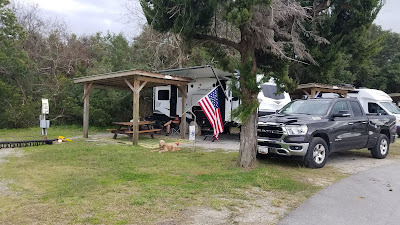

Onslow Beach FamCamp - Camp Lejeune, NC

We have water, electric, sewer and cable TV.  We are totally smoothing it here (not roughing it).  We walk on the empty off-season beach every day and watch and listen as the Marines train all around us.  Nothing beats the thump that reverberates through Vixen when they shoot off their heavy artillery.  And when an Osprey flies directly over your trailer, you can feel the props beat on the roof of the trailer. I'm loving it.  Seeing a bunch of Marines in fox holes pointing their weapons towards the road as we came back from food shopping was a trip.  It almost makes me want to go out and join them. Naw. On second thought.  I'll just keep smoothing it here. 

Boondockers Welcome

Boondockers Welcome is a subscription service where you pay an annual fee and gain access to Hosts, who are just plain people who offer their homes for you to park overnight or for a few nights.  

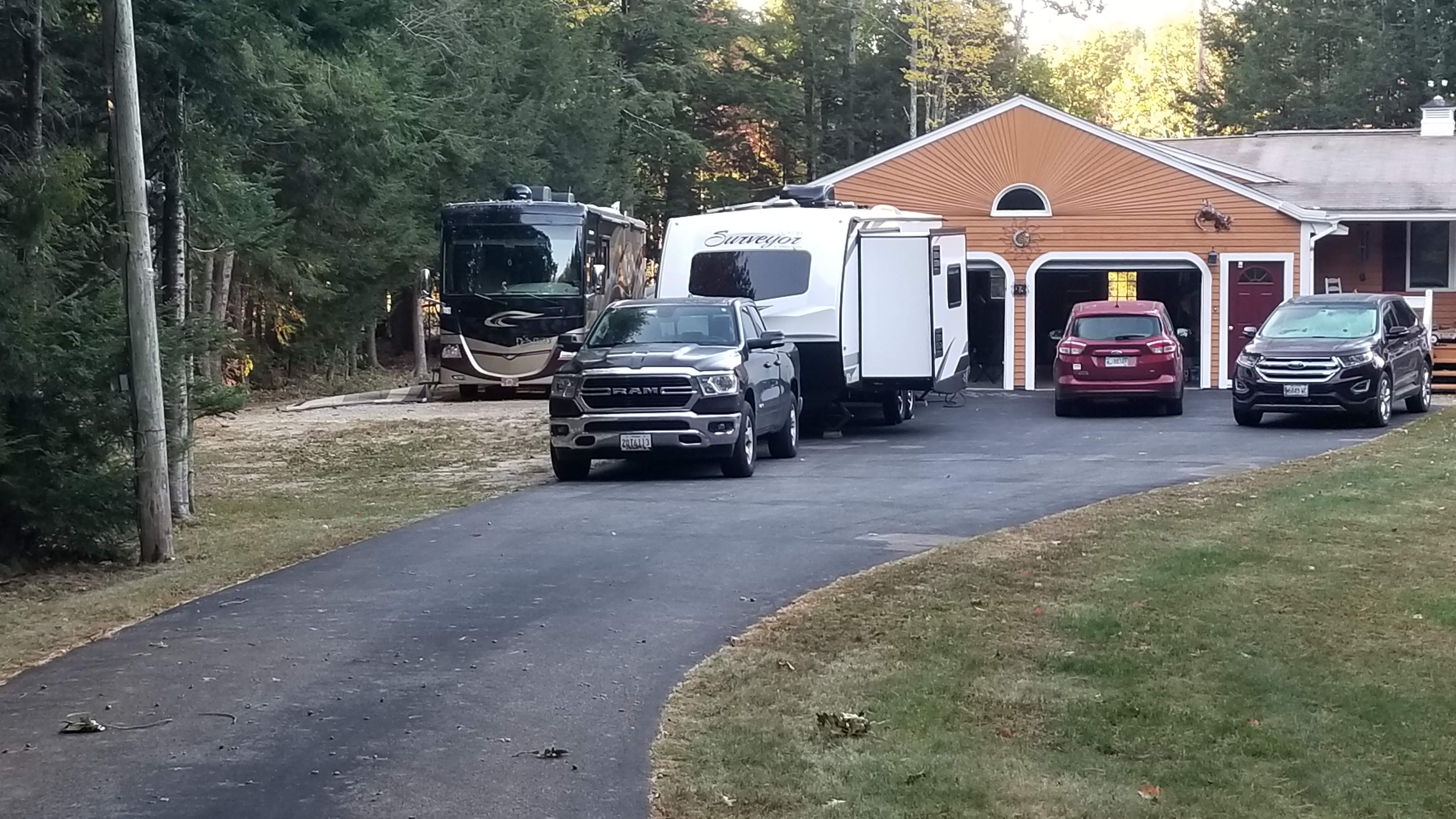
Our first Boondockers Welcome experience

Sometimes it's in their large driveway and others it is a field or large yard.  Some offer hookups at all levels, but usually you just need to be self contained. We used this service exclusively on our way back down from Maine, staying four nights at four different Host's houses.  


Next to a Host's barn

It's a mixed bag. I really enjoy the convenience of having a place to spend the night safely as we travel, but sometimes it isn't perfect. We are figuring what type of BWs we like as we try them out.  


In a Host's field

Requesting a night is very easy and all can be done on-line, along with communications with the Hosts.

Harvest Hosts

Harvest Hosts is another subscription service where this one is offering overnight camping at wineries, farms, distilleries and other businesses that have the space for a few rigs.  It costs more than Boondockers Welcome, and you are also expected to give the Hosts some business while you are there, and you usually have to call to reserve a site.


A Harvest Host Winery

It is another resource to use when we are traveling. We signed up just before leaving Home Base the last time and stayed at a Winery on our way to North Carolina.

Overnight Parking

One final resource that we have used is the Overnight parking method.  Walmarts are a popular spot, where you park at the back of the lot and try to remain respectful. For different reasons, Walmarts are becoming less available due to bad behavior or local ordinances.  

Cracker Barrel is a spot that we used on the way up to Maine.  They actually have about four or five spaces designated for RVs and Busses and it is ok to spend the night. Buying a meal while there, is a nice way to say thanks. 

Service Plazas are another place we tried out on the way up to Maine.  When we arrived, there was only a few other trucks and RVs around.  In the morning, the lot was full to overflowing.  Just remember, you are competing with the truckers at the service plazas, so stay respectful and stick to your lane. Don't extend out over your space, or you may have a rude awakening. 


Overnight in a Service Plaza

Some people don't like the constant rumble of the diesel trucks running all night, but it kind of reminds me when I was on a ship and the noises of fans, motors and other things were a constant companion.  It actually lulls me to sleep. 

There are other overnight places that we haven't tried yet, but are on our list of possibilities.  Casinos, Cabela's, Bass Pro, etc. 

In Conclusion

We are having a blast figuring out where we will be spending the night as we travel along, Homeless on Wheels. Planning our stays and building our adventure is all a part of the fun of being a Nomad.


Peace,

EarthTone and LoGear

And Ginger

And Vixen.  :)
Friday, December 4, 2020

Achievements, Badges and Abilities


I have created a few achievements, badges and abilities, that can be unlocked when a Long Distance Hiker takes a hike.  


Outsider Badge - (several tiers)  When you begin a long distance hike, you become an Outsider after spending your first night outside. To earn the Outsider Badge, one must spend the majority of time in the out-of-doors for a number of days.  No artificial climate control allowed except fire. Makeshift shelters (tent, lean-to) are ok, as long as they are not artificially climate controlled. 

To reach Tier I (Fledgling), you must spend 2 weeks outside, with no more than three nights indoors. 

Tier II (Journeyman) is two full cycles of the moon with no more than 12 nights in climate controlled spaces. 

Tier III (Master) is four full turnings of the Moon with no more than 24 nights in climate controlled spaces.


Long Distance Trekker (LDT) - The LDT achievement is first unlocked at Level 1 after you have completed your 2nd or 3rd resupply and have traveled from 75 to 100 miles.  The exact time of unlocking is determined by Pamola and will require an offering of fat and oil to initiate.  If you are successful, you become a Level 1 LDT.  Each level is achieved after sufficient time and distance and will always be at the approval of that whom you seek, Pamola.    

Level 2 = 200 miles. Level 3 = 500 miles. Level 4 = 1000 miles. Level 5 = 2000 miles.


Camp Cook Badge - Prepare, eat and digest five meals.  Each meal must have at least two different ingredients, but can be either cold or hot.  

Resupply Wizard Ability - Successfully find enough food to last from three to five days, five different times to unlock this ability.  

Funky Hiker Badge - To earn this badge you must accomplish the following tasks:  1. Have a fellow traveler that you meet, mention your smell.  2.  Have another open a window in your presence to find fresh air.  3. Have yourself seated in an "out of the way" area of a restaurant or bar.  


Smell the Roses Blue Blaze Achievement - Take five different blue blazed trails away from the main trail to visit interesting things and spectacular views.  This is above and beyond any blue blaze you take for water or shelter.  


Ride Finder Ability - Successfully secure three rides for yourself or your group.